
Which AI Engineer Certifications Do Indian Employers Respect?
What Indian employers look for in AI engineer credentials: vendor certificates, university programmes and project portfolios, plus what Rooman's Build AI t
If you are searching for an AI engineer course in India, you will find a crowded field. Rooman Technologies has trained 1.3 million engineers, and that experience shapes how we answer the question behind most searches: which AI engineer credentials do Indian employers actually respect? The honest answer is that no single certificate does the work alone. Employers read three things together: a recognised credential, structured learning, and proof that you can build. This guide breaks down each one, then explains what Rooman's Build AI track offers, using only what we can verify.
The short answer
Indian employers respect credentials that are recognised, current and backed by evidence of real work. A certificate gets your CV past a first filter. A portfolio gets you through the technical round. Clear thinking about trade-offs gets you the offer.

That means the strongest profile usually combines three layers:
- A vendor or industry-recognised credential that shows you know a platform or standard.
- A structured programme, from a university or a training provider, that shows you finished something rigorous.
- A project portfolio that shows you can ship working AI features.
Skip any layer and you leave a question in the recruiter's mind. Cover all three and you answer the question before it is asked.
What employers look for in an AI engineer
Hiring managers for AI engineering roles are rarely impressed by a long list of course names. They are trying to answer practical questions.
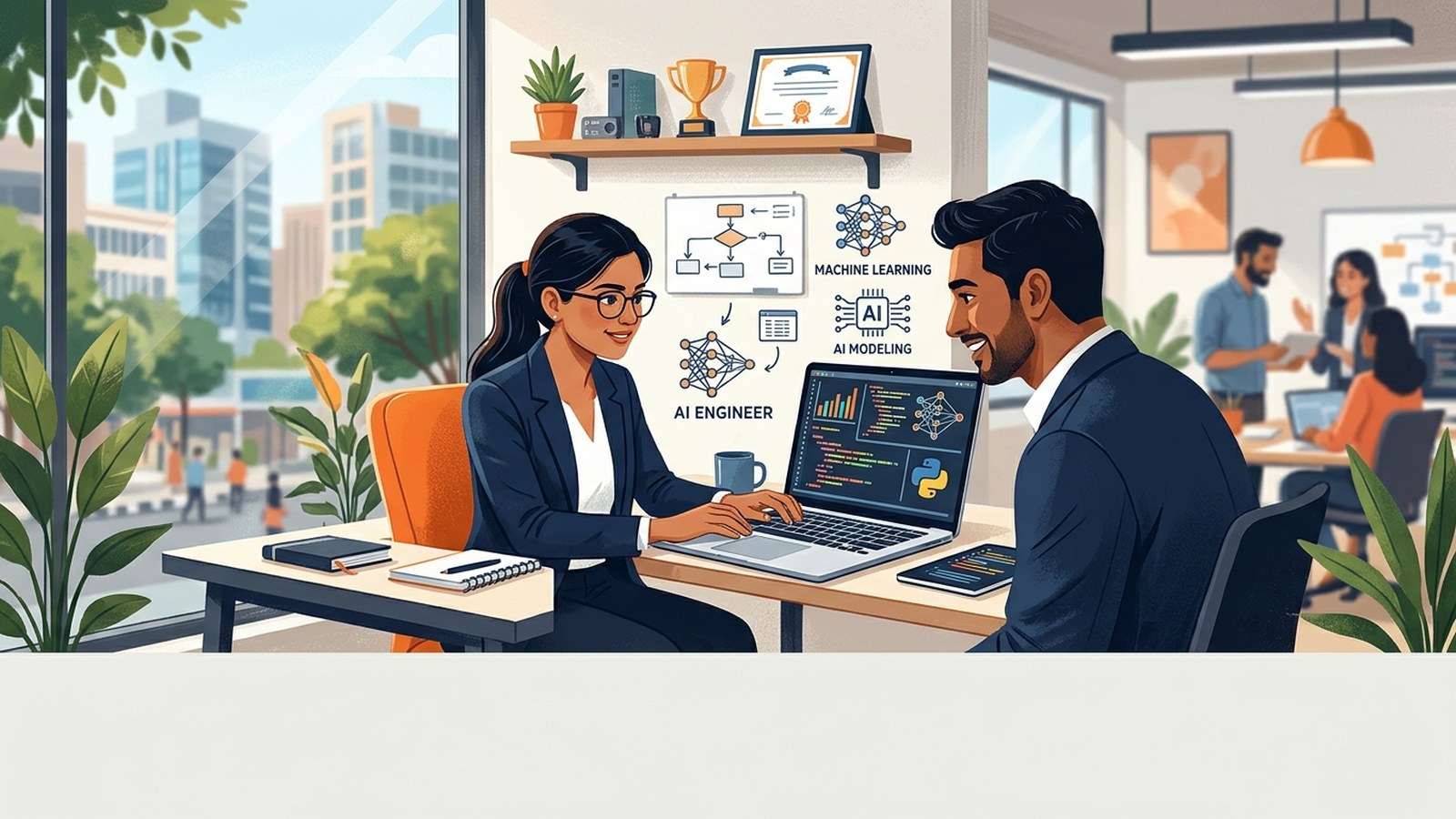
Can this person build, not just prompt? Using an AI tool is not the same as engineering a system around it. Employers look for people who can wire models into applications, handle data, and think about failure cases.
Do they understand the surrounding stack? AI features live inside real software. That means cloud, DevOps, security and clean engineering habits matter as much as model knowledge. A candidate who can deploy and monitor a feature is more useful than one who can only demo it in a notebook.
Can they explain their choices? In interviews, you will be asked why you chose an approach, what went wrong, and what you would change. Certificates cannot answer that for you. Projects you actually built can.
Are they still learning? AI tooling changes fast. A credential from years ago with nothing recent beside it tells an employer your learning stopped. Recent, relevant work signals the opposite.
Keep these four questions in mind as you read the rest of this guide. Every credential you choose should help you answer at least one of them.
Vendor certificates: what they prove
Vendor certificates come from the companies whose platforms employers actually use. Their value is straightforward: they show you can work with a specific cloud or technology environment, and they are tested against a standard that someone other than your trainer sets.
For AI engineer roles, vendor credentials tend to matter most when the employer runs on that vendor's stack. If a company builds on a particular cloud, a certificate from that cloud signals you will need less ramp-up time.
What vendor certificates do not prove is that you can design and ship something original. They test knowledge of a platform, not judgement about a problem. Treat them as a strong supporting layer rather than the whole story.
A useful check when choosing a provider: look at who accredits the training organisation itself. Rooman is accredited by NSDC, NASSCOM, Microsoft, AWS and IBM, and is ISO 9001:2015 and ISO 27001 certified and appraised at SEI-CMMI Level 3. Accreditation of the training provider is not the same as a vendor exam certificate, and you should always confirm exactly which credential a specific programme awards. But provider-level accreditation tells you the delivery itself has been audited by outside bodies.
University programmes: depth and signal
University-linked programmes carry a different kind of weight. They signal sustained effort, academic structure and often a recognisable institutional name. For some employers, especially larger and more traditional ones, that name reduces perceived risk.
Their strengths are depth in fundamentals, assessment discipline and a credential that is easy for HR teams to recognise. Their common weakness is pace: curricula can lag behind the tools engineers use every week, and some programmes lean theoretical.
If you choose a university route, look for these signs of a programme that will hold up with employers:
- Hands-on assignments that produce working code, not only written exams.
- Exposure to current tooling, not only classical methods.
- A capstone you can show and explain.
- Clear information about who teaches and how you are assessed.
University programmes and industry training are not rivals. Many strong candidates pair academic depth with project-driven, tool-focused training to cover both ends.
Project portfolios: the proof layer
If there is one thing that separates shortlisted AI engineer candidates from the rest, it is evidence. A portfolio turns claims into something a reviewer can open, run and question.
A convincing AI project portfolio has a few qualities:
- A real problem. Pick something a person or business would actually want solved, such as a support assistant, a document search tool or a voice interface.
- A working deployment. A link or a demo beats a screenshot. Even a modest cloud deployment shows you understand what happens after the model call.
- A readable repository. Clear structure, a README that explains the decisions, and honest notes on limitations.
- Evidence of iteration. Show what you tried, what failed and how you improved it. Interviewers love this because it mirrors real work.
- Security and cost awareness. Handling keys properly, thinking about data and noting cost trade-offs show maturity.
Two or three solid projects usually say more than ten shallow ones. Depth wins. And because this is the layer you control completely, it is the best place to invest extra hours.
How to compare any AI engineer course
Whether you are looking at Rooman or any other provider, use the same checklist. It keeps the decision about outcomes rather than branding.
- Curriculum relevance: Does it cover how AI features are actually built, deployed and secured?
- Project work: Will you finish with things you can show, not only certificates?
- Credential clarity: Can the provider tell you precisely what credential you receive and who issues it?
- Provider credibility: Are there outside accreditations, and how long has the organisation been operating?
- Employer connection: Does the provider have real relationships with hiring companies, and will they describe them honestly?
- Support: What happens when you are stuck, and who reviews your projects?
Ask these questions in writing if you can. A good provider will answer plainly. If answers are vague or lean entirely on big promises, take that as information.
What Rooman's Build AI track is built around
Build AI is Rooman's AI engineer track, designed for engineers building AI products, future AI engineers and AI Foundation graduates. Here is what we can say with confidence, because it comes from Rooman's company profile.
Rooman's programmes teach AI-augmented development, prompt engineering, cybersecurity, and cloud and DevOps through project-driven learning. That mix is deliberate. It matches the employer questions above: building rather than only prompting, understanding the surrounding stack, and producing work you can explain.
Behind the programmes is an organisation with a long track record. Rooman was founded in Bengaluru in 1999 and has been in operation for 27 years. It has 198 delivery centres across India and works across 13 international markets, with a presence in Dubai (DIFC) and Singapore. It works across four pillars: Learn, Staffing, GCC-as-a-Service and Transform. Because Rooman also builds AI products, including Omnis, CRM Voice Agent, AI Tutor and BlueLinked, a voice-built resume tool for blue-collar workers, the learning sits close to real product work.
We are deliberately not listing a duration, fee, syllabus breakdown or exam list here. If you want the current details of what the Build AI certificate includes, ask us directly through the enquiry form and we will share them as they stand today.
The hiring partners behind it
Rooman has 1,000+ hiring partners. That network is a genuine asset for learners, because relationships with employers help shape what skills are in demand and give graduates a wider set of doors to knock on.
Let us be precise about what this means. A large hiring-partner network is a strength of the organisation. It does not mean every partner is hiring AI engineers at any given moment, and it does not replace your own preparation. Your portfolio, your interview skills and your readiness still decide outcomes.
Rooman also serves 1,600+ Global Capability Centres. Capability centres are a major source of technology roles in India, so familiarity with how they operate informs how Rooman prepares talent. Use the network as support, and keep building your own evidence.
What we will not claim
We think trust matters more than hype in this category. So here is where we draw the line.
We will not tell you that one certificate makes you hireable. We will not quote salary numbers we cannot verify, and we will not promise outcomes that depend on your effort and the market. We will not claim that an employer recognises a credential unless we can confirm it.
What we can say is that Rooman has trained 1.3 million engineers over 27 years, teaches through projects, is accredited by recognised bodies, and works with a large network of hiring partners. The rest is up to you, and we will help you do it well.
A practical plan to become hireable
Here is a straightforward way to combine all three layers over a few months of focused work.
Start with fundamentals. Make sure your programming, data handling and cloud basics are solid. Weak foundations show up fast in AI projects.
Learn the AI-augmented workflow. Practise using AI tools to speed up development while still reviewing and testing everything yourself. Learn prompt engineering as an engineering skill: structured, tested and versioned.
Build your first project. Choose a small, real problem. Deploy it. Write the README.
Add the surrounding skills. Bring in cloud and DevOps practices, then think through security. Redeploy your project with proper configuration and monitoring.
Build a second, harder project. This time, add something you have not done before, such as a voice interface or a retrieval step, and document what you learned.
Add a recognised credential. Choose one that matches the stack you want to work on, and confirm exactly what it covers.
Rehearse explaining. Practise walking someone through your projects, your trade-offs and your mistakes. This is where interviews are won.
Who should start where
- Students and early-career engineers: Prioritise fundamentals and two strong projects, then add a credential.
- Working developers: Focus on AI-augmented development and deployment skills, and turn your day-job experience into a portfolio piece where permitted.
- AI Foundation graduates: Build AI is the natural next step, taking you from understanding AI to engineering with it.
Whichever group you belong to, the principle is the same: credentials open the door, projects get you through it.
Ready to take the next step?
If you want to know exactly what the Build AI certificate includes today and how it fits your background, share your details at rooman.com/enquire and our team will get back to you.
FAQ
Which certification matters most for an AI engineer in India?
No single one does. Employers look for a recognised credential, structured learning and a project portfolio together. Choose a credential that matches the stack you want to work on.
Do project portfolios really matter more than certificates?
They matter differently. Certificates help you get shortlisted. Portfolios let you demonstrate skill in technical rounds. The strongest candidates have both.
What does Rooman teach in its AI programmes?
Rooman's programmes teach AI-augmented development, prompt engineering, cybersecurity, and cloud and DevOps through project-driven learning.
Is Rooman accredited?
Rooman is accredited by NSDC, NASSCOM, Microsoft, AWS and IBM, and is ISO 9001:2015 and ISO 27001 certified and appraised at SEI-CMMI Level 3.
How many hiring partners does Rooman work with?
Rooman has 1,000+ hiring partners. The network supports learners, but your preparation and portfolio still decide your outcome.