
Query
Get the data you need.
Clean data in Excel, write SQL with joins and CTEs, and load data into pandas.
Rooman's Professional Programme in AI and Data Analytics is a 240-hour programme that takes you from Excel to SQL, Python, statistics and Power BI, then shows you how to use AI tools to clean data and write reports. You finish with capstone projects on real business data and earn the Rooman Certificate with NSDC recognition.
What you'll be able to do
Data analysts collect, clean and analyse data, then present it so a business can decide. This programme teaches the tools analysts use every day and how AI tools speed up the work.
Query
Clean data in Excel, write SQL with joins and CTEs, and load data into pandas.
Analyse
Explore data with Python, apply statistics and test hypotheses against business questions.
Present
Build Power BI dashboards and use AI tools to draft insights and reports.
Who it's for
The programme is for graduates of any stream with basic maths, and for professionals moving into data and AI roles. It starts from basics, so prior coding experience is optional.
Not sure which course fits? Take the 10-minute career assessment, or talk to a counsellor.
240 hours · 14 modules
Fourteen modules in the order analysts work: collect and clean in Excel and SQL, analyse in Python and statistics, visualise in Power BI, speed it up with AI, then capstone projects and job readiness.
What analysts do, and how data turns into decisions.
Topics covered
You produce: a set of KPIs for a business question.
Cleaning and calculating with data in Excel.
Topics covered
You produce: a cleaned dataset with formula-driven analysis.
Summarising data into reports managers use.
Topics covered
You produce: a sales performance and revenue analysis report.
Getting data out of relational databases.
Topics covered
You produce: queries that join and summarise business tables.
Applying SQL to real analytics and interview problems.
Topics covered
You produce: a customer and order analysis in SQL.
Loading and cleaning data in Python.
Topics covered
You produce: a clean pandas DataFrame from raw files.
Finding patterns in data and charting them.
Topics covered
You produce: an exploratory analysis of a real business dataset.
Measuring, comparing and testing what the data says.
Topics covered
You produce: a hypothesis test on a business question.
Connecting and modelling data for reporting.
Topics covered
You produce: a Power BI data model with KPIs.
Designing dashboards that lead to decisions.
Topics covered
You produce: an executive dashboard in Power BI.
Using AI tools to clean and explore data.
Topics covered
You produce: an AI-assisted exploratory analysis.
Automating summaries and using AI responsibly.
Topics covered
You produce: an AI-powered business insight report.
Analysing a full business problem end to end.
Topics covered
You produce: capstone analyses for your portfolio.
Getting ready for analytics interviews.
Topics covered
You produce: an interview-ready resume and LinkedIn profile.
Tools covered
You use the tools analytics teams rely on, plus AI tools that speed up the work.
| Tool group | Tools | What you use them for |
|---|---|---|
| Spreadsheets | Excel | Clean data, calculate and build MIS reports |
| Databases | SQL | Query and join business data |
| Programming | Python, pandas, NumPy, Matplotlib, Seaborn | Analyse and chart data |
| Business intelligence | Power BI, DAX | Model data and build dashboards |
| AI tools | OpenAI APIs, Hugging Face | Speed up cleaning, analysis and reporting |
Capstone
Your capstone projects cover retail sales and customer behaviour, HR attrition and performance, financial data and marketing campaign performance. Each goes from raw data to a dashboard and a recommendation.
Most modules end with a project on a real business dataset.
Your credential
The Rooman Certificate, with NSDC recognition. You earn the Rooman Certificate, recognised by NSDC, when you complete the programme and its capstone projects.
Placement support runs alongside the final modules: resume workshops, mock interviews, job referrals and Rooman's placement drive. Your capstone projects become the portfolio you take to interviews.
What's included
Before you enrol
Can't find your answer? Call 080 6945 1000 or WhatsApp us.
Graduates of any stream with basic maths, and professionals moving into data or AI roles.
No. The programme starts from basics and builds up gradually.
Excel, SQL, Python, Power BI, and AI tools such as OpenAI APIs and Hugging Face.
It adds generative AI to the analytics workflow: you use AI tools to clean data, explore it and draft insight reports.
240 hours, including projects. Rooman runs evening and weekend batches.
Residential, online or hybrid. Rooman runs evening and weekend batches, and a counsellor will tell you which formats your batch offers.
A project in most modules, plus capstones on retail sales, HR attrition, financial data and marketing campaigns.
Yes. You get resume workshops, mock interviews and job referrals, and you take part in Rooman's placement drive.
The Rooman Certificate, with NSDC recognition, and a portfolio of your analyses.
Talk to a Rooman counsellor on 080 6945 1000 or WhatsApp +91 97390 86029. They will share current fees, payment options and upcoming batch dates.
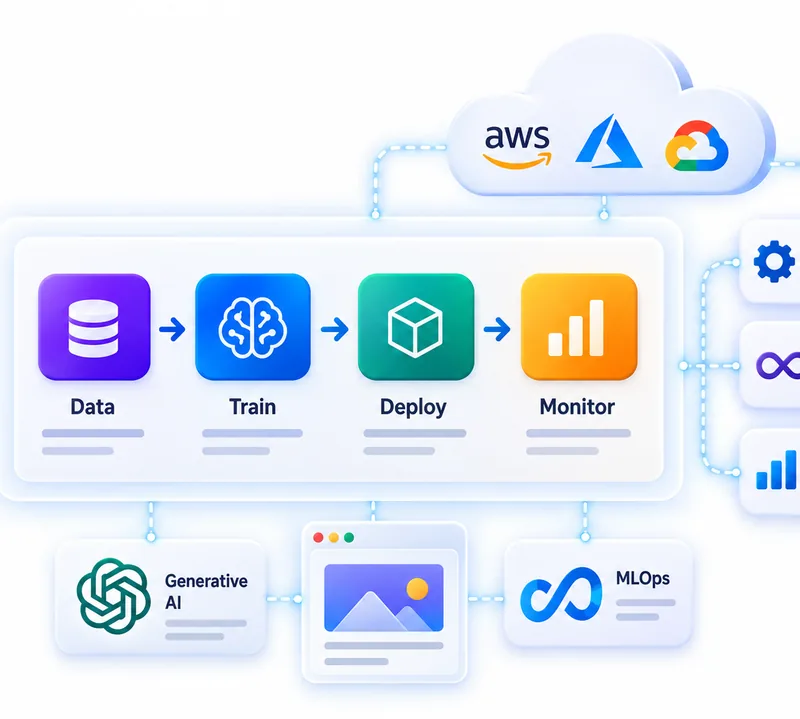 240 hrs12 modulesGenerative AI and MLOpsBuild AI systems, then run them in production.
 240 hrs12 modulesFull Stack Development with Gen AIBuild MERN apps with AI features inside.
 240 hrs12 modulesCloud and DevOpsBuild, ship and run applications on AWS.For companiesTraining your whole team?Run any programme as a private batch for your team, with the same curriculum, labs and projects.Talk to us
Next step
Tell us your degree or current role, and a counsellor will call you with batch dates, fees and payment options.
Course details reviewed on 25 September 2026.