Empower Your Future with Rooman Technologies’ Virtual Internship Programs
Industry-Aligned, Skill-Building Internships Designed to Propel Your Career Forward

Proven Legacy. Unmatched Impact.
Trainees – Last Year
for Internships
in 26 Years
About Program
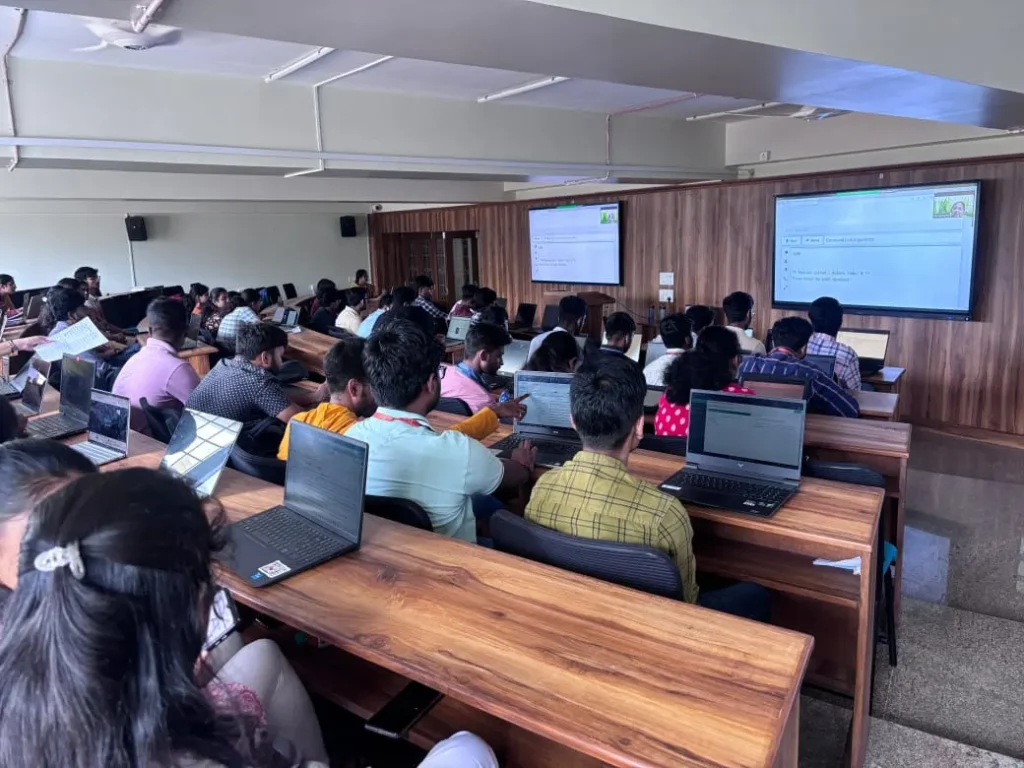
At Rooman, our internship program is specifically designed to equip students and freshers with the skills they need to succeed in today’s competitive job market. Moreover, through virtual, project-based learning, you will gain hands-on experience in real-world scenarios while receiving expert guidance from industry professionals. Whether you are pursuing a career in IT, design, marketing, or another field, this internship offers an excellent opportunity to build a strong foundation and, consequently, stand out from the crowd.
Courses Offered


Why Choose Program
Industry-Endorsed Curriculum
Designed in alignment with current market demands and emerging technologies.
Project-Based Learning
Work on real-world projects to gain hands-on experience.
Flexible Learning Modes
Combination of live interactive sessions and self-paced modules.
Expert Mentor Support
Guidance from experienced industry professionals throughout the program.
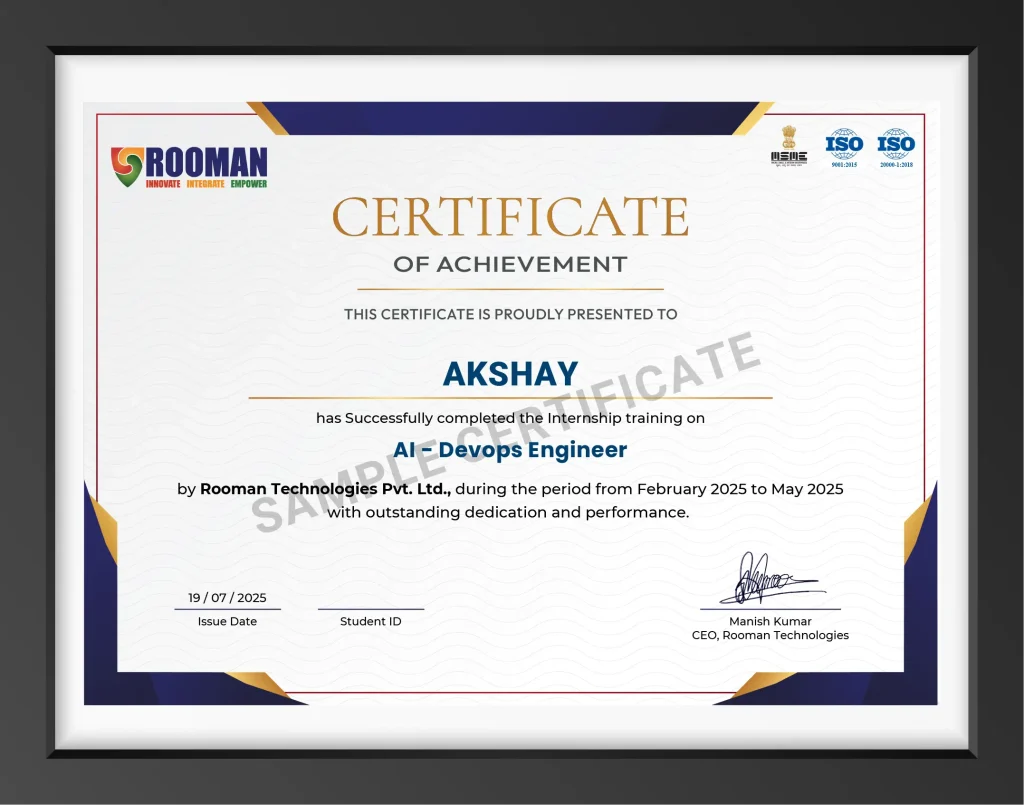
Verified Completion Certificate
Recognized certification from Rooman Technologies to enhance your resume.
Career-Focused Outcomes
Build in-demand skills that improve employability and open new opportunities.
Certificates
Real-Time Projects
Leverage IBM Watson's advanced AI capabilities to comprehensively analyze customer interactions across multiple channels, including emails, chat, and social media. In addition, integrate Watson's AI services to extract deep insights, such as customer intent, sentiment trends, and emerging issues.
Develop a scalable, real-time social media analytics pipeline to process live data from platforms such as Twitter and Facebook. Moreover, utilize Apache Kafka, Spark Streaming, and NLP models for sentiment analysis, trend detection, and entity recognition, thereby allowing brands to monitor their reputation, track emerging trends, and respond promptly.
To begin with, conducting advanced exploratory data analysis on large-scale genomic datasets enables the identification of genetic variations. Moreover, these variations can then be linked to diseases, thereby uncovering potential associations for further investigation. Furthermore, apply techniques such as Principal Component Analysis (PCA) and t-Distributed Stochastic Neighbor Embedding (t-SNE) for dimensionality reduction and visualization. In addition, utilize statistical tests and correlation analysis to uncover significant genetic markers and patterns.
Furthermore, leverage advanced clustering techniques, such as DBSCAN and Hierarchical Clustering, combined with dimensionality reduction methods like t-SNE, to effectively analyze and visually map customer journeys across multiple touchpoints.
Leverage transformer-based models, such as BERT (Bidirectional Encoder Representations from Transformers) and GPT (Generative Pre-trained Transformer), for advanced natural language understanding tasks. In addition, apply these models to sophisticated NLP applications — including question answering, text summarization, and document comprehension — to achieve state-of-the-art performance in language processing.
Moreover, employ Bayesian optimization techniques to automate model selection and hyperparameter tuning for machine learning models. In addition, leverage tools such as Hyperopt or Optuna to efficiently explore the hyperparameter space and identify the best-performing models based on cross-validated performance metrics. Consequently, this approach improves model accuracy while optimizing computational resources.
Develop an ensemble regression model that combines techniques such as Gradient Boosting, Random Forests, and XGBoost to achieve accurate real estate valuations. In addition, incorporate diverse data sources — including historical property sales, economic indicators, and neighborhood attributes — to further improve prediction accuracy and deliver more comprehensive property valuations.
Furthermore, leverage deep learning-based clustering techniques, such as Deep Embedded Clustering, to effectively segment market data. By integrating neural networks with clustering algorithms, one can uncover hidden patterns and, moreover, identify customer segments within complex datasets. Consequently, this integration enables more targeted marketing strategies and, in addition, facilitates personalized product offerings.
Implement a real-time language translation system using advanced neural machine translation models, such as Transformer-based architectures. Furthermore, optimize the model for low-latency, high-quality translations across multiple languages, thereby supporting applications in international communication and travel.
In order to enhance prediction accuracy, it is essential to develop automated ensemble systems that, furthermore, combine multiple machine learning models into a unified framework. Moreover, implement techniques such as stacking, blending, and bagging within automated pipelines to select and optimize the best-performing models based on validation results.
To begin with, implementing advanced AI-driven anomaly detection algorithms makes it possible to identify atypical patterns in financial transaction data. Moreover, this approach strengthens fraud detection and, as a result, enhances overall financial security. Moreover, this approach involves employing machine learning models — such as Isolation Forest and Autoencoders — to identify potential fraudulent activities or errors, thereby enhancing both data integrity and security.
In addition, leverage sophisticated AI techniques — including supervised learning algorithms and clustering methods — to efficiently clean and validate customer data within CRM systems. Then, develop algorithms to detect and resolve inaccuracies, duplicate entries, and incomplete records, thereby improving the overall reliability of customer profiles.
By applying Natural Language Processing (NLP) together with machine learning techniques, the data cleansing process for electronic health records (EHRs) can be automated. Consequently, this not only improves efficiency but also ensures higher accuracy in healthcare data management. In particular, this includes standardizing medical terminology, correcting typographical errors, and ensuring consistency across patient records by leveraging AI models trained on healthcare-specific data.
To improve reliability, AI models can be integrated, and as a result, the quality of sensor data is significantly enhanced. As a result, predictive maintenance systems for industrial equipment become more accurate and, moreover, more efficient. Furthermore, employ data validation techniques and machine learning algorithms to clean the sensor data, thereby ensuring accurate predictions of equipment failures and optimizing maintenance schedules.
To promote fairness, AI-driven tools should be implemented to identify and, moreover, address biases within training datasets. Consequently, this ensures that machine learning models become more accurate, reliable, and, moreover, ethically sound. Furthermore, apply techniques such as Fairness Constraints and Adversarial Debiasing to identify and correct biased data distributions, thereby ensuring equitable and unbiased outcomes in AI model predictions.
By deploying AI algorithms, organizations can monitor and validate the quality of real-time streaming data from IoT sensors or financial markets. Furthermore, this approach ensures data reliability and, in addition, supports more accurate decision-making. In addition, implement techniques such as stream data validation and anomaly detection to carry out real-time accuracy checks, thus ensuring the consistency and completeness of streaming data.
Moreover, leverage AI to improve the quality of data integration when consolidating information from diverse sources. In addition, apply data matching and merging algorithms — such as entity resolution and similarity joins — to maintain accuracy and ensure consistency across integrated datasets for analytics.
To begin with, AI can be utilized to automate the monitoring of data quality within cloud-based data warehouses. As a result, this not only improves accuracy but also, moreover, enhances the efficiency of data management processes. Moreover, develop models to continuously assess data quality metrics, detect anomalies, and generate alerts for any integrity issues, thereby ensuring high standards of data governance.
By applying advanced NLP techniques, it becomes possible to improve the quality of textual data. Furthermore, apply algorithms for text normalization, entity recognition, and sentiment analysis to clean and validate data originating from sources such as customer reviews and social media.
By implementing AI models, organizations can validate and standardize data across supply chain management systems. In addition, employ machine learning techniques to ensure data accuracy in inventory records, order processing, and supplier information, thereby facilitating consistent and reliable supply chain operations.
When a development team encounters long deployment times and frequent production issues, adopting DevOps practices can help improve efficiency and reliability. Specifically, this involves implementing strategies such as continuous integration, continuous deployment, infrastructure as code, and automated testing to streamline the development and deployment processes.
When an organization aims to establish a CI/CD pipeline to automate its deployment process, essential components include version control systems, build servers, automated testing tools, and deployment tools. Moreover, each component must be configured to work seamlessly together to efficiently automate the build, test, and deployment phases.
Managing infrastructure for a microservices application requires consistent and repeatable deployments. Therefore, tools such as Ansible and Terraform can be used to automate infrastructure provisioning and configuration. Consequently, this approach ensures that the infrastructure setup remains reliable and scalable.
When a company aims to implement proactive monitoring to prevent downtime, it involves leveraging monitoring tools to track system performance, detect anomalies, and configure alerts for potential issues. As a result, potential problems can be addressed before they impact availability.
When a team faces challenges in managing security across diverse environments, adopting DevSecOps practices can help. Specifically, this approach involves automating security processes, integrating security tools into the CI/CD pipeline, and ensuring that security measures are consistently enforced in every environment.
When an organization aims to adopt a multi-cloud strategy using containers, technologies such as Docker and Kubernetes can be leveraged to manage containerized applications across various cloud environments, thereby ensuring greater flexibility and scalability.
Since managing configurations across multiple environments can be complex, leveraging Ansible for automation simplifies the process by delivering consistent configuration management and ensuring that settings are applied uniformly in every environment.
When a team utilizes multiple collaboration tools, integration can become a challenge. Therefore, streamlining their usage entails selecting the most suitable integrations and ensuring the tools operate seamlessly together to enhance productivity and minimize complexity.
Moreover, evaluating the effectiveness of automation strategies requires monitoring performance metrics, assessing the impact of automation on deployment speed and quality, and pinpointing areas for improvement.
Adopting a cloud-native approach involves designing applications that fully leverage cloud services and deploying them using container orchestration tools such as Kubernetes. Furthermore, IBM Cloud provides the necessary infrastructure and services to efficiently build and manage cloud-native applications.
Cloud platforms offer scalable web hosting solutions that enable businesses to deploy and manage websites and web applications efficiently; moreover, they seamlessly adapt to dynamic traffic demands. By leveraging services such as auto-scaling and load balancing, cloud infrastructure can automatically adjust resources based on current traffic loads, thereby ensuring optimal performance and availability.
Cloud-based backup and recovery solutions offer a secure and scalable way to protect critical data. Furthermore, by storing backups in the cloud, organizations can ensure their data remains safe from hardware failures, natural disasters, or accidental deletions. In addition, automated backup schedules and convenient data restoration options enable rapid recovery and significantly reduce downtime.
Moreover, cloud services empower organizations to efficiently analyze large volumes of data by leveraging distributed computing frameworks such as Apache Hadoop and Apache Spark. Cloud platforms provide scalable storage and processing power, enabling businesses to perform complex analytics and, moreover, gain valuable insights from big data without the need to manage physical infrastructure.
Cloud-based disaster recovery solutions provide businesses with the ability to quickly recover from disruptive events. Moreover, by leveraging cloud resources, organizations can implement failover and recovery processes that minimize downtime and data loss, thereby ensuring continuity of operations during emergencies.
Cloud platforms offer flexible environments for development and testing, enabling developers to provision, configure, and scale resources as needed. Consequently, this allows for rapid experimentation and testing of new features or applications without the constraints of physical hardware or infrastructure limitations.
Cloud-based CDNs enhance the delivery of web content by caching and distributing it across multiple edge locations worldwide. As a result, latency is reduced, and load times are improved for end-users by serving content from servers geographically closer to them, thereby ensuring a better overall user experience.
Cloud computing supports the development and management of IoT applications by offering scalable infrastructure; furthermore, it enables efficient processing and analysis of data from connected devices. Furthermore, cloud platforms offer tools and services for data ingestion, real-time analytics, and integration with other applications, thereby facilitating the creation of effective IoT solutions.
Cloud services provide robust platforms for developing and deploying AI and machine learning models. Moreover, organizations can leverage pre-built AI services, train custom models, and scale computational resources as needed, thereby enabling advanced analytics and intelligent application features without the need to invest in on-premises hardware.
Cloud-based CRM systems offer comprehensive tools for managing customer interactions, sales, marketing, and support. Furthermore, since they are accessible from anywhere with an internet connection, these solutions enable businesses to track customer data, automate sales processes, and enhance customer service.
Cloud-based Virtual Desktop Infrastructure (VDI) provides employees with secure remote access to their desktop environments. Moreover, this approach supports flexible work arrangements by allowing users to access their workstations, applications, and data from various locations, thereby enhancing both productivity and collaboration.
Design an e-commerce platform with a React.js front end and a Node.js/Express.js back end, while addressing challenges in data synchronization, real-time updates, authentication, and secure payments.
Implement a serverless architecture using IBM Cloud Functions to process and analyze real-time data from IoT devices. Additionally, examine how serverless functions can handle variable workloads, while considering the associated benefits and limitations of this approach.
Develop a RESTful API for a task management application and integrate it with a React.js front end. Furthermore, explore strategies for designing API endpoints, managing state in React.js, and ensuring secure communication between the client and server.
Migrate a legacy application’s database from MySQL to MongoDB and implement a hybrid approach to manage both existing and new data. Examine data migration challenges, strategies for ensuring consistency, and the benefits of using MongoDB over MySQL.
Implement a Continuous Integration and Continuous Deployment (CI/CD) pipeline for a web application using tools such as Jenkins or GitHub Actions. Describe how to automate build, test, and deployment processes, and outline strategies for effective deployment rollbacks.
Deploy an application and leverage performance monitoring tools such as New Relic or Datadog to track its performance. In addition, explain how to configure monitoring, analyze performance data, and implement optimizations based on the insights obtained.
Develop a plan to implement sustainable and inclusive practices within a technology company; moreover, focus on promoting diversity, reducing the carbon footprint, and measuring the overall impact of these initiatives.
Design a scalable cloud-based application using AWS or Azure services. In addition, examine how to leverage cloud resources to handle varying workloads, optimize costs, and ensure both high availability and robust disaster recovery.
Build a web application that requires real-time synchronization between the front end and back end. In addition, explore how to implement WebSockets or similar technologies to enable real-time updates while ensuring state consistency across all components.
Develop a security plan for a RESTful API used in a financial application. Furthermore, examine the implementation of authentication and authorization mechanisms, rate limiting, and data encryption to protect the API from potential security threats.
Your Career Growth Starts Here
Don’t just learn—experience real industry projects, gain mentor guidance, and earn a certificate that employers trust.
FAQ's
A structured, online internship that combines training, real-world project work, and mentor support to help you gain industry-ready skills.
Students, fresh graduates, and working professionals looking to upskill or switch careers in technology fields.
Basic computer skills are sufficient for most programs. Some advanced tracks may require foundational knowledge, which will be mentioned in the program details.
Through live instructor-led classes, self-paced learning modules, and online collaborative tools for project work.
Yes, every participant is assigned an experienced industry mentor for personalized guidance.
Programs typically range from 4 to 6 weeks, depending on the track you choose.
Yes, you will receive a verified completion certificate from Rooman Technologies upon meeting all requirements.
Yes, our industry-endorsed curriculum and certification are valued by employers and can strengthen your resume.
Absolutely. The flexible structure allows you to balance learning with your current commitments.
Simply click on the “Enroll Now” button on this page, fill out the registration form, and complete the payment process to secure your spot.