
Professional in Machine Learning & Deep Learning
Build smart systems with deep expertise -Build Automate Master AI
100% Placement Assistance | 1000+ Hiring Partners
- Industry-Relevant Curriculum
- Hands-On Training
- Experienced Instructors
- Placement Assistance
- Live Real-Time Projects
Course Duration
240+ Hrs
Offline Mode
₹ 75000
Start Date
April 08, 2026
Online Mode
₹ 45000
Offline Mode
₹ 75000
Start Date
April 08, 2026
Course Duration
270 Hrs
Online Mode
₹ 45000

Professional in Machine Learning & Deep Learning
Build smart systems with deep expertise -Build Automate Master AI Build Automate Master AI
Course Duration
240+ Hrs
Course Overview
This comprehensive program equips learners with foundational to advanced skills in Machine Learning (ML), Deep Learning (DL), and Time Series Analysis. Designed for data-driven professionals, the course integrates mathematical foundations, real-world ML algorithms, and industry-standard tools like Scikit-learn, XGBoost, TensorFlow, and PyTorch to build robust, production-ready models. Learners also gain hands-on experience with feature engineering, model evaluation, and neural networks to solve real-world AI problems.
Key Features
- Covers end-to-end ML lifecycle from math to deployment
- Prepares for roles in AI, ML engineering, and data science
- Aligned with industry tools and model optimization practices
- Equips learners with deep technical as well as practical ML understanding
Skills Covered
- Mathematics for ML: Probability, Linear Algebra, Calculus
- Core ML: Supervised & Unsupervised Learning, Scikit-learn
- Modeling: Regression, Classification, Clustering, Ensembles
- Model Evaluation: Cross-validation, Metrics, Pipelines
- Model Evaluation: Cross-validation, Metrics, Pipelines
- Advanced ML: XGBoost, CatBoost, Hyperparameter Tuning
Course Curriculum
Machine Learning & Deep Learning
- Module 1 – Mathematics & Statistics for Machine Learning
- Module 2 – Machine Learning Fundamentals
- Module 3 – Advanced Machine Learning
- Module 4 – Time Series Forecasting & Analysis
- Module 5 – Deep Learning Applications
- Module 6 – Neural Networks
- Hypothesis Testing Understand how to make data-driven decisions using statistical hypothesis testing.Learn concepts like null/alternative hypotheses and significance levels.
- Chi-Square Testing Use the chi-square test to assess relationships between categorical variables. Helpful in feature selection and A/B testing.
- IQR(Interquartile Range) Analyze data spread and detect outliers using IQR. Learn how to visualize distribution with box plots.
- Range and central tendency Explore basic statistics like mean, median, mode, and range. Build a foundation for analyzing data distribution and variability.
- P-value Learn how to interpret p-values to determine statistical significance in hypothesis testing. Essential for model validation.
- Linear Algebra Understand vectors, matrices, and transformations—core mathematical tools behind ML models, especially deep learning.
- Calculus Learn basic derivatives and gradients used in model optimization and backpropagation in machine learning.
- Matrices Explore matrix operations like multiplication, inversion, and eigenvalues—key to representing and computing in ML algorithms.
- Supervised learning (Regression, Classification) Learn to train models on labeled data to predict outcomes using regression and classification techniques. Understand real-world use cases like price prediction and sentiment analysis.
- Scikit-learn Use Python’s most popular ML library to build, train, and evaluate models. Learn tools for preprocessing, model selection, and performance evaluation.
- Model metrics Evaluate model performance using metrics like accuracy, precision, recall, F1-score, and RMSE. Choose the right metric based on problem type.
- Unsupervised Explore clustering and dimensionality reduction techniques like K-Means and PCA. Discover hidden patterns in data without predefined labels.
- Reinforcement machine learning Understand how agents learn optimal actions through rewards and penalties. Apply concepts like Q-learning and Markov Decision Processes.
- Feature engineering Transform raw data into meaningful features that boost model accuracy. Learn encoding, scaling, interaction features, and more.
- Ensemble models Combine multiple models to improve accuracy using methods like bagging, boosting, and stacking. Explore Random Forest, XGBoost, and others.
- Pipelines Build reusable ML workflows with Scikit-learn Pipelines. Chain together preprocessing and modeling steps for clean, efficient code.
- Cross-validation Improve model generalization by validating it on different data subsets. Learn k-fold cross-validation and train-test-split strategies.
- XGBoost Learn XGBoost, a powerful gradient boosting algorithm known for speed and accuracy. Widely used in ML competitions and real-world applications.
- CatBoost Explore CatBoost, a gradient boosting library optimized for categorical features. Efficient, scalable, and less sensitive to parameter tuning.
- Hyperparameter tuning Improve model performance by optimizing hyperparameters using techniques like Grid Search and Random Search with cross-validation.
- Model interpretability Understand how models make predictions using tools like SHAP, LIME, and feature importance. Essential for building trust in ML decisions.
- Trend/seasonality Identify long-term trends and recurring seasonal patterns in time series data. Essential for accurate forecasting and business planning.
- Moving average Smooth out short-term fluctuations to reveal trends using rolling averages. Used in signal processing and stock market analysis.
- ARIMA (AutoRegressive Integrated Moving Average) Model time series data with trends and noise using ARIMA. Combines autoregression, differencing, and moving averages for powerful forecasting.
- SARIMA(Seasonal ARIMA) Extend ARIMA to handle seasonal patterns explicitly. Ideal for monthly, quarterly, or cyclic data with repeating trends.
- Prophet(by Meta) Use Facebook Prophet for quick, flexible time series forecasting. Handles seasonality, holidays, and missing data with ease.
- Seasonality decomposition Break down time series into trend, seasonality, and residual components. Helps visualize and analyze each influence separately.
- Image classification Train deep learning models to recognize and categorize images using CNNs (Convolutional Neural Networks). Applied in areas like facial recognition and medical imaging.
- Sentiment analysis Use NLP and deep learning to determine the sentiment (positive, negative, neutral) behind textual data such as reviews, tweets, or feedback.
- Tabular DL models Apply deep learning techniques to structured/tabular data using models like TabNet. Optimize performance on datasets typical in business and finance.
- Transfer learning Leverage pre-trained models to accelerate training and improve accuracy on smaller datasets. Useful in computer vision and NLP tasks.
- Batch norm Improve training speed and stability by normalizing inputs across layers. Helps reduce internal covariate shift in deep networks.
- Dropout Prevent overfitting by randomly disabling neurons during training. Enhances generalization by promoting model robustness.
- Optimizers Learn how optimizers like SGD, Adam, and RMSProp adjust weights during training to minimize loss and improve convergence.
- Loss functions Measure model prediction error using functions like Cross-Entropy or MSE. A crucial part of training and guiding model learning.
- Neurons Understand the basic computational unit of neural networks, inspired by the human brain. Learn how neurons process inputs to produce activations.
- Perceptron Explore the simplest type of neural network used for binary classification. Learn how perceptrons form the basis for deeper architectures.
- Activation functions Use functions like ReLU, Sigmoid, and Tanh to introduce non-linearity in models. Crucial for learning complex patterns in data.
- Gradient descent Master the optimization algorithm that minimizes model error by adjusting weights. Understand learning rate, cost function, and convergence.
- Convolutional Neural Networks (CNNs) Build models for image processing using convolutional layers, pooling, and filters. Widely used in visual recognition tasks.
- Recurrent Neural Networks (RNNs) Basics Understand how RNNs handle sequential data like text or time series. Learn about loops, memory, and limitations like vanishing gradients.
- TensorFlow/PyTorch setup Set up the two most widely used deep learning frameworks. Learn environment setup, GPU use, and writing your first model.
Salary Scale
Job Role
- Machine Learning Engineer
- Data Scientist
- AI Engineer
- Deep Learning Specialist
- Time Series Analyst
- NLP or Computer Vision Engineer
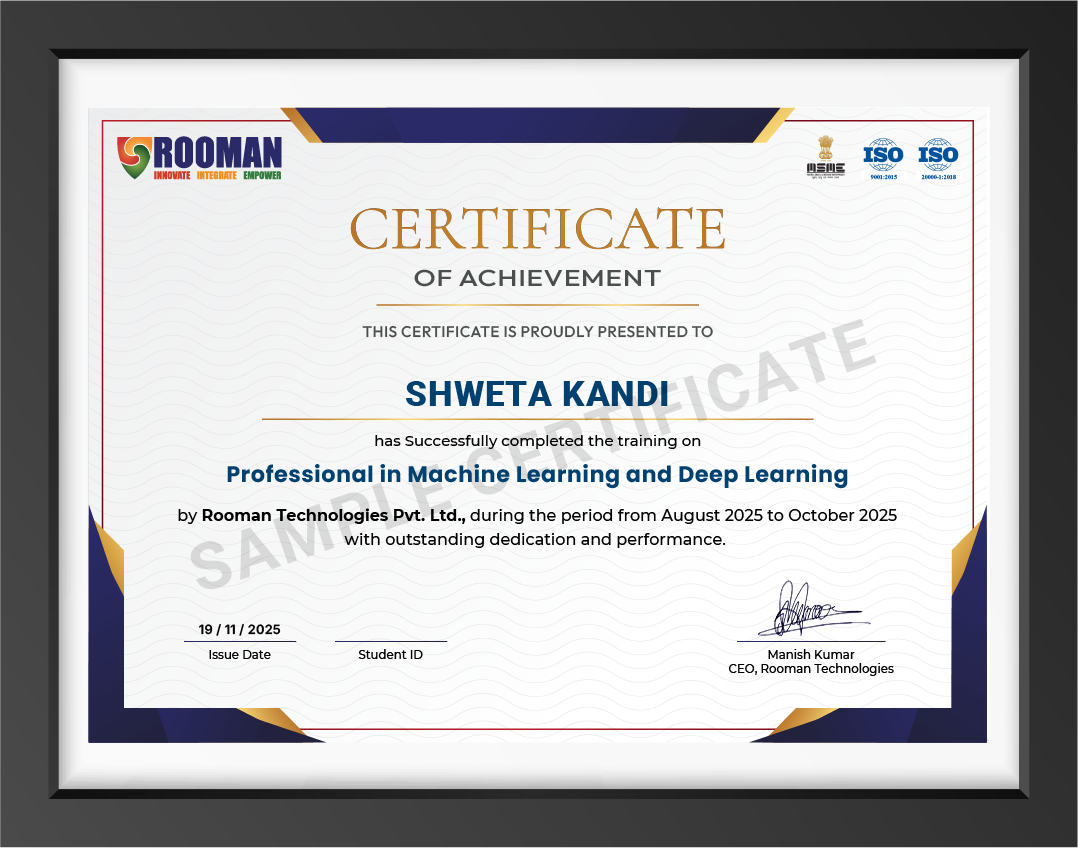
Course Certificate
Eligible Criteria
- B.E/B.Tech in ECE, EEE, Instrumentation (Final Year or Recent Graduates)
- Possess good English communication skills
- Have a minimum of 70% marks throughout their academics
Tools & Technologies



Training Options
Online Training
- Certified Industry Expert Trainers
- AI-Powered LMS with 1-Year Access
- 100+ Practical Exercises & 5+ Real-World Projects
- Interview Preparation & Job Assistance
- Industry-Recognized Course Completion Certificate
- In-Person Mentorship & Doubt Solving
- Fully Equipped Labs & Collaborative Learning
- Campus-Like Environment with Exclusive Networking
Classroom Training
- Certified Industry Expert Trainers
- AI-Powered LMS with 1-Year Access
- 100+ Practical Exercises & 5+ Real-World Projects
- Interview Preparation & Job Assistance
- Industry-Recognized Course Completion Certificate
- In-Person Mentorship & Doubt Solving
- Fully Equipped Labs & Collaborative Learning
- Campus-Like Environment with Exclusive Networking
Why Join this Program
Earn a job
Receive complete job assistance tailored to your career goals. Get expert placement guidance to confidently step into the industry.
Leverage knowledge from industry experts
Learn directly from seasoned Trainers and Gain real-world insights that go beyond textbooks.
Industry-relevant Tools & Practical Learning
Get hands-on experience with the latest tools used by top companies. Hands-on learning through 200+ exercises and 10+ projects with seamless access to integrated labs.
Structured, industry-vetted curriculum
A curriculum shaped by experts to meet evolving industry demands. Structured learning ensures you're career-ready from day one.
Integrated with Gen AI Modules
The curriculum includes cutting-edge Generative AI modules designed to align with emerging tech trends.
Interview preparation & Placement assistance
Sharpen your interview skills with practical training and expert guidance. Receive complete placement support to connect with top recruiters.
Program FAQ
Yes. It starts from fundamental math concepts and gradually progresses to advanced topics.
Projects include real-time demand forecasting, image classification, AI chat modeling, and customer sentiment analysis.
Basic programming (Python preferred) and math background is helpful but not mandatory.
Yes. Resume building, mock interviews, and placement support are part of the package.
No. Deep learning is taught from scratch, including neural networks, CNNs, and RNNs.