
Professional in Generative AI and MLOps
Transform ideas into scalable AI solutions – Prompt, Generate, Operationalize
100% Placement Assistance | 1000+ Hiring Partners
- Industry-Relevant Curriculum
- Hands-On Training
- Experienced Instructors
- Placement Assistance
- Live Real-Time Projects
Course Duration
240+ Hrs
Offline Mode
₹ 75000
Start Date
April 06, 2026
Online Mode
₹ 45000
Offline Mode
₹ 75000
Start Date
April 06, 2026
Course Duration
270 Hrs
Online Mode
₹ 45000

Professional in Generative AI and MLOps
Transform ideas into scalable AI solutions - Prompt Generate Operationalize Prompt Generate Operationalize
Course Duration
240+ Hrs
Course Overview
This program is designed to build deep proficiency in Generative AI, MLOps, and scalable AI application deployment. It covers modern NLP and CV, LLMs, prompt engineering, multi-modal AI systems, and industrial-grade MLOps tools. The curriculum balances practical AI development (via OpenAI, Gemini, LangChain) with advanced deployment (via FastAPI, Triton, Kubernetes), ensuring learners can build, deploy, and manage AI systems responsibly and at scale.
Key Features
- Generative AI hands-on: GPT, BERT, LangChain, RAG
- Industry-aligned curriculum combining AI and MLOps
- Exposure to both text and image generation models
- Enterprise-level MLOps tools: MLflow, Kubeflow, Docker, Triton
Skills Covered
- Transformers: BERT, GPT, NER, Sentiment Analysis
- NLP & Computer Vision Foundations
- Prompt Engineering & Fine-tuning
- MLOps: CI/CD, Model Versioning, MLflow, Kubeflow
- Generative AI: Text, Image, Multimodal (RAG, GANs)
- Model Serving: Flask, FastAPI, Streamlit, Triton, Kubernetes
Course Curriculum
Generative AI and MLOps
- Module 1 – Foundations of NLP and Computer Vision
- Module 2 – LLMs, Transformers & Prompt Engineering
- Module 3 – Generative AI & Agentic Systems
- Module 4 – MLOps
- Module 5 – Model Deployment & Serving at Scale
- Module 6 – Responsible AI: Ethics, Bias & Governance
- Tokenization The process of converting text into smaller units like words or subwords, preparing it for input into NLP models. It’s the foundational step in transforming language into machine-readable format.
- Embeddings Convert words or images into dense numerical vectors that capture meaning, relationships, or features. Used across NLP and computer vision tasks to enhance learning.
- Text Classification Automatically categorize textual data (e.g., emails, reviews) into predefined classes using deep learning models. Applications include spam detection, topic labeling, and sentiment analysis.
- Image Processing Preprocess and transform raw images through resizing, filtering, or normalization. Ensures data quality and consistency before model training.
- Image Classification Train deep learning models to assign labels to images. Used in applications like product recognition, medical diagnostics, and safety surveillance.
- Facial Recognition Use deep learning algorithms to detect, recognize, or verify individual faces from images or video. Key in authentication, access control, and personalization systems.
- GPT(Generative Pre-trained Transformer) Study transformer-based models like GPT that understand and generate human-like text. Explore applications such as chatbots, content generation, and coding copilots.
- Transformers Understand the architecture behind modern NLP models that use attention mechanisms to process sequences in parallel. Backbone of models like BERT and GPT.
- BERT(Bidirectional Encoder Representations from Transformers) A pre-trained transformer model that understands context from both directions. Used for tasks like question answering and NER.
- GPT(Generative Pre-trained Transformer) Explore autoregressive language models like GPT that generate coherent human-like text. Useful for chatbots, summarization, and content creation.
- Named Entity Recognition (NER) Identify and classify named entities (like people, places, organizations) in text. Widely used in information extraction and document tagging.
- Sentiment Analysis Determine the emotional tone behind textual content (positive, negative, neutral). Applied in social media monitoring and customer feedback.
- Fine-Tuning Customize pre-trained models like BERT/GPT on domain-specific data to improve task performance. Essential for adapting models to specific applications.
- Prompt Engineering Craft effective prompts to guide responses from large language models like GPT. Crucial for optimizing accuracy in zero- or few-shot learning setups.
- OpenAI APIs Integrate powerful capabilities like text generation, code completion, and embeddings using OpenAI’s models (e.g., GPT, DALL·E). Enables AI-driven applications with minimal setup.
- Gemini APIs Access Google’s Gemini models for advanced multimodal interactions including text, images, and reasoning. Ideal for enterprise and scalable AI integrations.
- Text/Image Generation Create human-like text or realistic images using generative models like GPT and DALL·E. Power use cases in content creation, design, and personalization.
- RAG Pipelines (Retrieval-Augmented Generation) Enhance generative models with external knowledge by retrieving relevant documents in real-time. Boosts accuracy in Q&A, chatbots, and enterprise AI.
- Multimodal Models Train and use models that understand and generate across multiple input types like text, images, and audio. Examples include Gemini and GPT-4 with vision.
- LangChain Build advanced AI apps by chaining together LLM calls, tools, and memory. Enables dynamic decision-making, document QA, and chat agents.
- LangGraph Extend LangChain with graph-based state management for multi-step, branching AI workflows. Ideal for agents and tool-using LLM systems.
- GANs (Generative Adversarial Networks) Use two neural networks — generator and discriminator — to create highly realistic synthetic data. Applied in deepfakes, art, and simulations.
- A2A Protocol (Agent-to-Agent) Facilitate secure, structured communication between autonomous AI agents. Useful for collaborative task execution and decentralized systems.
- MCP(Multi-Agent Collaboration Protocol)
- ML Lifecycle Covers the complete process from data collection to model deployment and monitoring. Ensures repeatability and reliability in ML systems.
- Model Tracking Monitor performance, parameters, and artifacts of multiple model versions over time. Essential for experimentation and auditability.
- Versioning Maintain control over datasets, code, and model changes using tools like Git and DVC. Critical for collaboration and rollback in production.
- Automation Pipelines Automate repetitive tasks like data preprocessing, model training, and validation using tools like Airflow or Kubeflow Pipelines.
- CI/CD for ML Implement continuous integration and delivery for ML projects. Automates testing, validation, and deployment of updated models.
- Data Drift Detection Identify changes in incoming data distribution that can degrade model performance. Helps trigger model retraining or alert mechanisms.
- Docker Use containerization to package ML applications with their dependencies. Ensures consistent runtime environments across development and production.
- MLflow Track experiments, package models, and manage the ML lifecycle. Supports reproducibility and collaboration in model development.
- Kubeflow Deploy, scale, and manage machine learning workflows on Kubernetes. Enables end-to-end MLOps infrastructure in production environments.
- Pipeline Orchestration Coordinate complex ML workflows with scheduling, dependency management, and monitoring. Tools include Prefect, Airflow, and Argo.
- Enterprise Infrastructure Design scalable, secure, and cloud-native architectures for ML systems. Integrates storage, compute, monitoring, and governance.
- Flask A lightweight Python web framework to turn ML models into web applications and APIs. Ideal for quick deployments and prototyping.
- FastAPI A modern, high-performance web framework for building fast, asynchronous APIs. Great for production-grade ML model deployment.
- AWS/GCP Deployment Learn how to deploy ML applications and APIs on leading cloud platforms like Amazon Web Services and Google Cloud. Covers compute, storage, and CI/CD.
- Streamlit Create interactive dashboards and data science web apps with minimal code. Perfect for showcasing ML models and analytics results.
- Kubernetes Automate deployment, scaling, and management of containerized ML services. Critical for production-grade model serving in cloud environments.
- Model Serving Package and expose trained models via REST APIs or gRPC endpoints for real-time inference. Ensures fast, scalable access to predictions.
- ONNX(Open Neural Network Exchange) A format to export and run ML models across platforms and frameworks. Supports cross-framework interoperability and optimized runtime.
- Triton An NVIDIA-powered serving platform to deploy models at scale with support for TensorFlow, PyTorch, ONNX, and more. Enables GPU-accelerated inference.
- Scalable APIs Build robust APIs that handle large user loads, enable authentication, logging, and error handling. Key for production-grade AI applications.
- Deepfakes AI-generated synthetic media that mimics real people’s appearance or voice. Raises ethical concerns in misinformation, consent, and identity misuse.
- Explainable AI (XAI) Design AI models whose decisions can be understood and interpreted by humans. Vital for transparency in sectors like healthcare, finance, and law.
- GDPR(General Data Protection Regulation) A European Union regulation that governs how personal data is collected, processed, and protected. Affects AI systems using user data.
- Bias Refers to unfair patterns in training data or models that lead to discriminatory predictions. Must be identified and corrected for ethical AI.
- Fairness Ensures that AI systems treat all user groups equitably across race, gender, and demographics. Integral to building inclusive AI systems.
- Privacy Protecting individual data from unauthorized access or misuse in AI systems. Involves techniques like anonymization, encryption, and federated learning.
- Governance Frameworks Structured guidelines and policies to ensure ethical development, deployment, and auditing of AI technologies. Examples include OECD, NIST, and AI Act.
Salary Scale
Job Role
- Generative AI Engineer
- MLOps Engineer
- AI/ML Product Developer
- LLM Application Developer
- AI Infrastructure Specialist
- AI Model Deployment Engineer
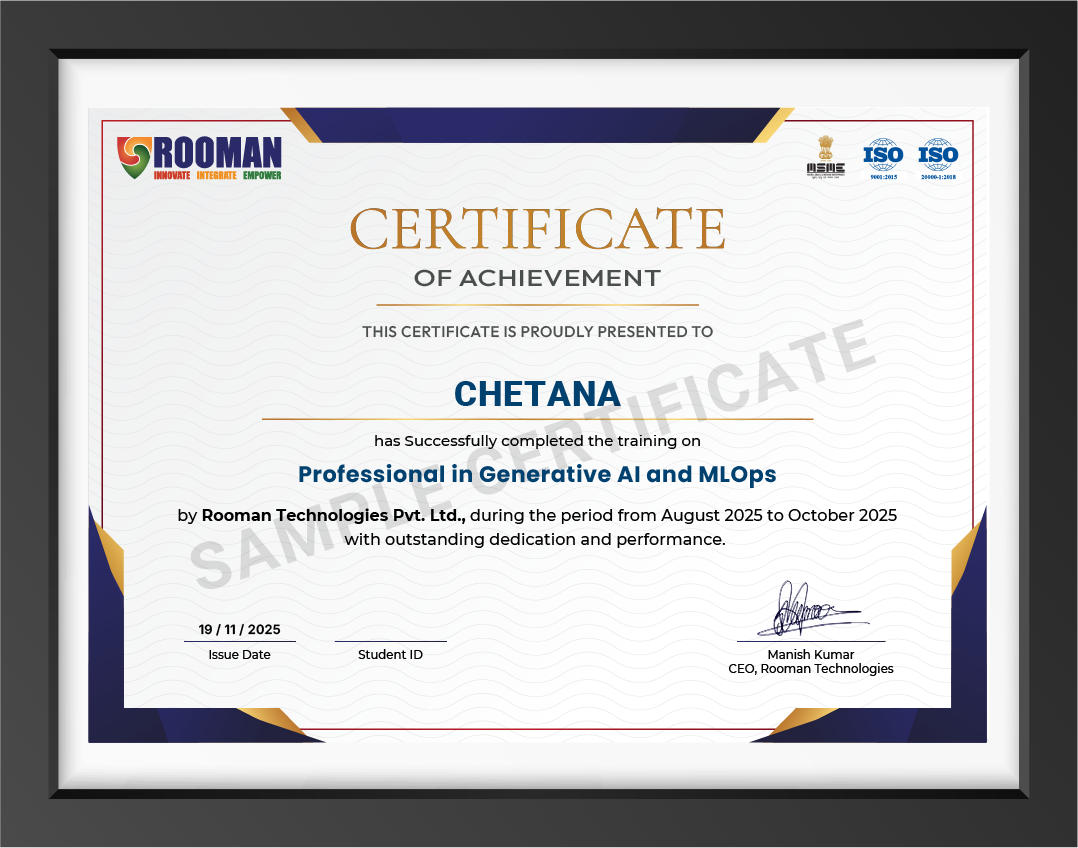
Course Certificate
Eligible Criteria
- B.E/B.Tech in ECE, EEE, Instrumentation (Final Year or Recent Graduates)
- Possess good English communication skills
- Have a minimum of 70% marks throughout their academics
Tools & Technologies







Training Options
Online Training
- Certified Industry Expert Trainers
- AI-Powered LMS with 1-Year Access
- 100+ Practical Exercises & 5+ Real-World Projects
- Interview Preparation & Job Assistance
- Industry-Recognized Course Completion Certificate
- In-Person Mentorship & Doubt Solving
- Fully Equipped Labs & Collaborative Learning
- Campus-Like Environment with Exclusive Networking
Classroom Training
- Certified Industry Expert Trainers
- AI-Powered LMS with 1-Year Access
- 100+ Practical Exercises & 5+ Real-World Projects
- Interview Preparation & Job Assistance
- Industry-Recognized Course Completion Certificate
- In-Person Mentorship & Doubt Solving
- Fully Equipped Labs & Collaborative Learning
- Campus-Like Environment with Exclusive Networking
Why Join this Program
Earn a job
Receive complete job assistance tailored to your career goals. Get expert placement guidance to confidently step into the industry.
Leverage knowledge from industry experts
Learn directly from seasoned Trainers and Gain real-world insights that go beyond textbooks.
Industry-relevant Tools & Practical Learning
Get hands-on experience with the latest tools used by top companies. Hands-on learning through 200+ exercises and 10+ projects with seamless access to integrated labs.
Structured, industry-vetted curriculum
A curriculum shaped by experts to meet evolving industry demands. Structured learning ensures you're career-ready from day one.
Integrated with Gen AI Modules
The curriculum includes cutting-edge Generative AI modules designed to align with emerging tech trends.
Interview preparation & Placement assistance
Sharpen your interview skills with practical training and expert guidance. Receive complete placement support to connect with top recruiters.
Program FAQ
A basic ML understanding is helpful, but we cover all essentials from scratch.
Yes. You’ll build RAG pipelines, fine-tune models, and call OpenAI/Gemini APIs in real use cases.
Absolutely. It includes capstone projects, mock interviews, and portfolio support.
AWS and GCP are covered for deployment, along with Kubernetes for scaling.
You’ll work with MLflow, Kubeflow, Docker, CI/CD, and Triton for scalable model serving.