
Professional in Cyber Security Expert
Powering Smart Decisions -Analyze, Decode, Data Drive Impact
100% Placement Assistance | 1000+ Hiring Partners
- Industry-Relevant Curriculum
- Hands-On Training
- Experienced Instructors
- Placement Assistance
- Live Real-Time Projects
Course Duration
240+ Hrs
Course Duration
240+ Hrs
Offline Mode
₹ 75000
Online Mode
₹ 45000

Course Overview
The Cyber Security Expert program is designed to equip learners with practical and in-depth skills across the cybersecurity lifecycle. From mastering security foundations and ethical hacking to operating SOC environments and securing cloud infrastructure, this course offers a well-rounded path to becoming a cyber defense professional. Learners will engage with tools like Nmap, Nessus, Metasploit, Wireshark, Splunk, and ELK, and understand how to defend, detect, and respond to real-world cyber threats.
Key Features
- Industry-relevant, hands-on training
- Covers on-premise, network, cloud & endpoint security
- Includes Ethical Hacking, SIEM, and SOC readiness
- Exposure to Red Team and Blue Team tools
Skills Covered
- Information Security Principles (CIA triad, policies)
- Network Defense (Firewalls, IDS/IPS, VPNs)
- OS Hardening (Windows & Linux)
- Cloud Security Best Practices (AWS, Azure)
- Identity & Access Management (IAM)
- Vulnerability Scanning (Nmap, Nessus)
Course Curriculum
Cyber Security Expert
- CIA triad The cornerstone of cybersecurity—Confidentiality, Integrity, and Availability—ensuring data is protected, accurate, and accessible to authorized users.
- Threat landscape Explore the evolving range of cyber threats, including phishing, ransomware, insider threats, and APTs (Advanced Persistent Threats).
- Malware types Understand different malicious software types like viruses, worms, trojans, spyware, and ransomware, and how they affect systems.
- Security policies Learn how organizations define rules and procedures for cybersecurity, covering acceptable use, password policies, and incident response.
- Responsive Design Design web applications that adapt seamlessly across screen sizes and devices using flexible layouts and media queries.
- Tailwind (optional) Use Tailwind CSS, a utility-first framework, to rapidly build modern, responsive, and customizable UIs with minimal custom CSS.
- Firewalls Hardware or software systems that monitor and control incoming and outgoing network traffic based on pre-defined security rules to block unauthorized access.
- IDS/IPS (Intrusion Detection/Prevention Systems) Tools that detect (IDS) and actively prevent (IPS) malicious traffic, unauthorized access, or anomalous behavior within a network.
- VPNs(Virtual Private Networks) Secure tunnels that encrypt your internet connection, protecting data transmission and enabling private remote access to internal networks.
- Port scanning Technique used to discover open ports and services on a system, often used by network admins for assessment or attackers for exploitation.
- Vulnerability scanning (Nmap, Nessus) Automated tools like Nmap and Nessus help identify weaknesses or outdated software across systems to proactively secure the network.
- Hardening Linux & Windows Apply best practices and security controls to minimize vulnerabilities in both Linux and Windows systems by disabling unused services and enforcing policies.
- Patching Regularly update systems with security patches and software fixes to close known vulnerabilities and prevent exploit attacks.
- Permissions Enforce access control using proper user/group permissions to restrict unauthorized actions on critical files and directories.
- Secure configurations Establish and maintain secure baseline settings for system components, including firewall rules, registry settings, and system services.
- Phases of hacking Understand the ethical hacking lifecycle: Reconnaissance, Scanning, Gaining Access, Maintaining Access, and Covering Tracks — aligned with CEH standards.
- Reconnaissance The information-gathering phase where hackers identify targets, open ports, services, and potential vulnerabilities before launching an attack.
- Exploitation Leverage identified vulnerabilities to gain unauthorized access or execute payloads — ethically done to test system security.
- Tools like Metasploit, Wireshark, Offensive Python Use industry-standard tools for penetration testing, network sniffing, and writing custom attack/defense scripts with Python for ethical hacking scenarios.
- Incident response Learn how to detect, investigate, contain, and recover from cybersecurity incidents through structured response plans and playbooks.
- SOC operations Understand the daily functioning of a Security Operations Center — including monitoring, threat triage, and escalation processes handled by analysts.
- SIEM tools (Splunk, ELK, etc.) Gain hands-on experience with Security Information and Event Management tools like Splunk and ELK Stack to analyze logs, detect threats, and automate alerts.
- Identity & Access Mgmt (IAM) Control who can access cloud resources and what actions they can perform using role-based access, MFA, and fine-grained permissions.
- Cloud-specific threats Understand risks unique to cloud environments such as misconfigurations, insecure APIs, and data exposure in multi-tenant setups.
- Shared responsibility model Learn how cloud security is divided between the provider and the customer — with clearly defined roles for data, infrastructure, and application safety.
- Secure cloud design (AWS/Azure) Build and audit secure architectures on platforms like AWS and Azure using encryption, VPCs, IAM roles, logging, and network security best practices.
- Module 1 – Information Security Foundations
- Module 2 – Network Security & Firewalls
- Module 3 – System & OS Security
- Module 4 – Ethical Hacking & Pen Testing
- Module 5 – Security Operations & SIEM
- Module 6 – Cloud Security
Salary Scale
Job Role
- SOC Analyst
- Network Security Engineer
- Cybersecurity Analyst
- Cloud Security Engineer
- Ethical Hacker
- Security Operations Specialist
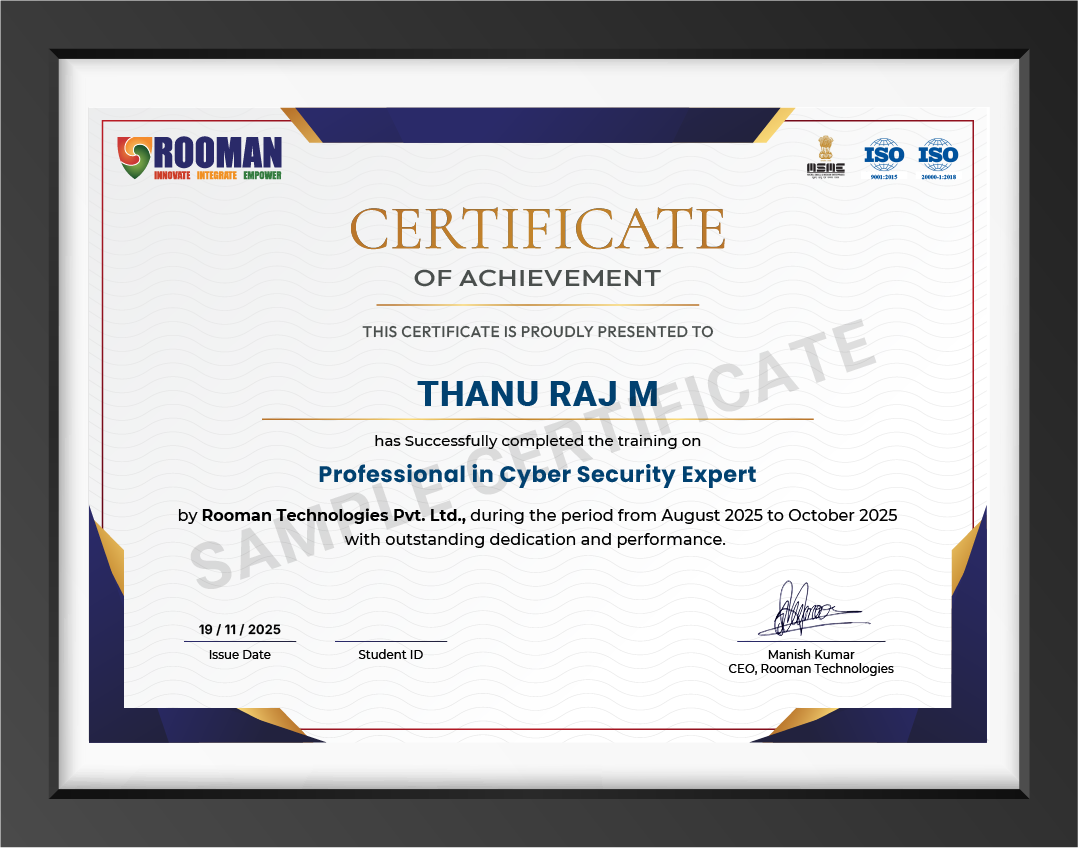
Course Certificate
Eligibility Criteria
- B.E/B.Tech in ECE, EEE, Instrumentation (Final Year or Recent Graduates)
- Possess good English communication skills
- Have a minimum of 70% marks throughout their academics
Tools & Technologies











Training Options
Online Training
- Certified Industry Expert Trainers
- AI-Powered LMS with 1-Year Access
- 100+ Practical Exercises & 5+ Real-World Projects
- Interview Preparation & Job Assistance
- Industry-Recognized Course Completion Certificate
- In-Person Mentorship & Doubt Solving
- Fully Equipped Labs & Collaborative Learning
- Campus-Like Environment with Exclusive Networking
Classroom Training
- Certified Industry Expert Trainers
- AI-Powered LMS with 1-Year Access
- 100+ Practical Exercises & 5+ Real-World Projects
- Interview Preparation & Job Assistance
- Industry-Recognized Course Completion Certificate
- In-Person Mentorship & Doubt Solving
- Fully Equipped Labs & Collaborative Learning
- Campus-Like Environment with Exclusive Networking
Why Join this Program
Earn a job
Receive complete job assistance tailored to your career goals. Get expert placement guidance to confidently step into the industry.
Leverage knowledge from industry experts
Learn directly from seasoned Trainers and Gain real-world insights that go beyond textbooks.
Industry-relevant Tools & Practical Learning
Get hands-on experience with the latest tools used by top companies. Hands-on learning through 200+ exercises and 10+ projects with seamless access to integrated labs.
Structured, industry-vetted curriculum
A curriculum shaped by experts to meet evolving industry demands. Structured learning ensures you're career-ready from day one.
Integrated with Gen AI Modules
The curriculum includes cutting-edge Generative AI modules designed to align with emerging tech trends.
Interview preparation & Placement assistance
Sharpen your interview skills with practical training and expert guidance. Receive complete placement support to connect with top recruiters.
Program FAQ
No, this course starts from the basics.
Yes, Linux administration begins with CLI basics.
Yes — it’s aligned with real roles in IT infrastructure.
Network setups, user configurations, scripting, etc.
Yes, it forms the base for AWS, Azure, DevOps roles.
Can be delivered offline, hybrid.